May Mobility is taking its autonomous driving ambitions global. The Michigan-based robotaxi startup announced Thursday that it has secured a strategic equity investment from Singapore’s ride-hailing giant Grab as part of its push to expand operations in Southeast Asia next year.
The partnership will see May Mobility’s self-driving technology integrated into Grab’s existing ride-hailing systems — from fleet management to vehicle matching and routing. The move sets the stage for one of the most significant collaborations yet between a U.S. autonomous vehicle startup and an established regional ride-hailing platform. It also marks a key step toward making robotaxis a commercial reality in dense, high-traffic markets.
Both companies see the deal as more than an investment. It’s a way to build a blueprint for how self-driving taxis can be deployed and managed inside large-scale ride-hailing ecosystems. May Mobility declined to disclose the size of Grab’s equity stake, but the partnership underscores its growing credibility within the transportation industry.
“We believe AVs have an important role to play in the future of mobility in Southeast Asia, complementing our driver network as well as public transport systems. Grab is intent on taking an active role in facilitating the introduction of AVs with a safety-first approach, and in a way that benefits the wider community,” said Dominic Ong, General Manager of Autonomous at Grab. “We see our partnership with May Mobility as a powerful synergy of hyperlocal expertise and global capabilities. We are excited to learn from them and work with them to adapt their technology to Southeast Asia’s needs.”
This isn’t May Mobility’s first ride-hailing collaboration. The startup recently partnered with Lyft to launch self-driving cars in Atlanta and is preparing a rollout with Uber in the U.S. The Grab deal now extends that strategy into one of the most complex and promising markets for urban mobility.
May Mobility plans to leverage GrabMaps — Grab’s AI-powered mapping technology — to study road conditions and driving behavior unique to Southeast Asia. GrabMaps processes real-time data from local cities to produce hyper-accurate, constantly updated navigation systems. That local insight will help May Mobility safely adapt its autonomous vehicles for regional deployment.
The startup already has a track record of strong industry backing. In November 2023, it secured a 10 billion yen (about $65.8 million) investment from Japan’s NTT to advance its self-driving technology. NTT, which is also working with Toyota to test self-driving buses and taxis, is one of several strategic investors betting on May Mobility’s technology as the bridge between experimental pilot programs and scalable, real-world adoption, Reuters reported.
Grab has been deepening its involvement in autonomous transport as well. Earlier this year, a Singapore district selected the company to operate autonomous shuttle routes in partnership with Chinese robotaxi firm WeRide, with deployment expected in early 2026.
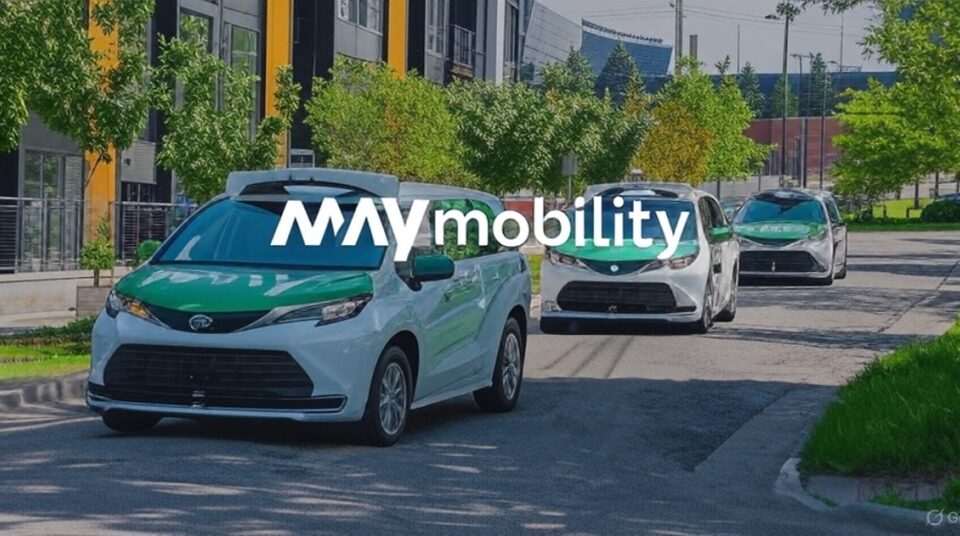
Founded in 2017 by Alisyn Malek, Edwin Olson, and Steve Vozar, May Mobility uses modified Toyota Siennas for smaller rides and Italian-built Tecnobus electric minibuses for higher-capacity routes. The startup envisions a future where self-driving systems make urban transportation safer, more efficient, and more accessible — and where roads are shared between human-driven and fully autonomous vehicles.
May Mobility began commercial driverless rides in the U.S. earlier this year, marking an important milestone for the company. Now, with Grab’s investment and regional data expertise, the startup is preparing to take its driverless ambitions to one of the most dynamic transportation markets in the world.